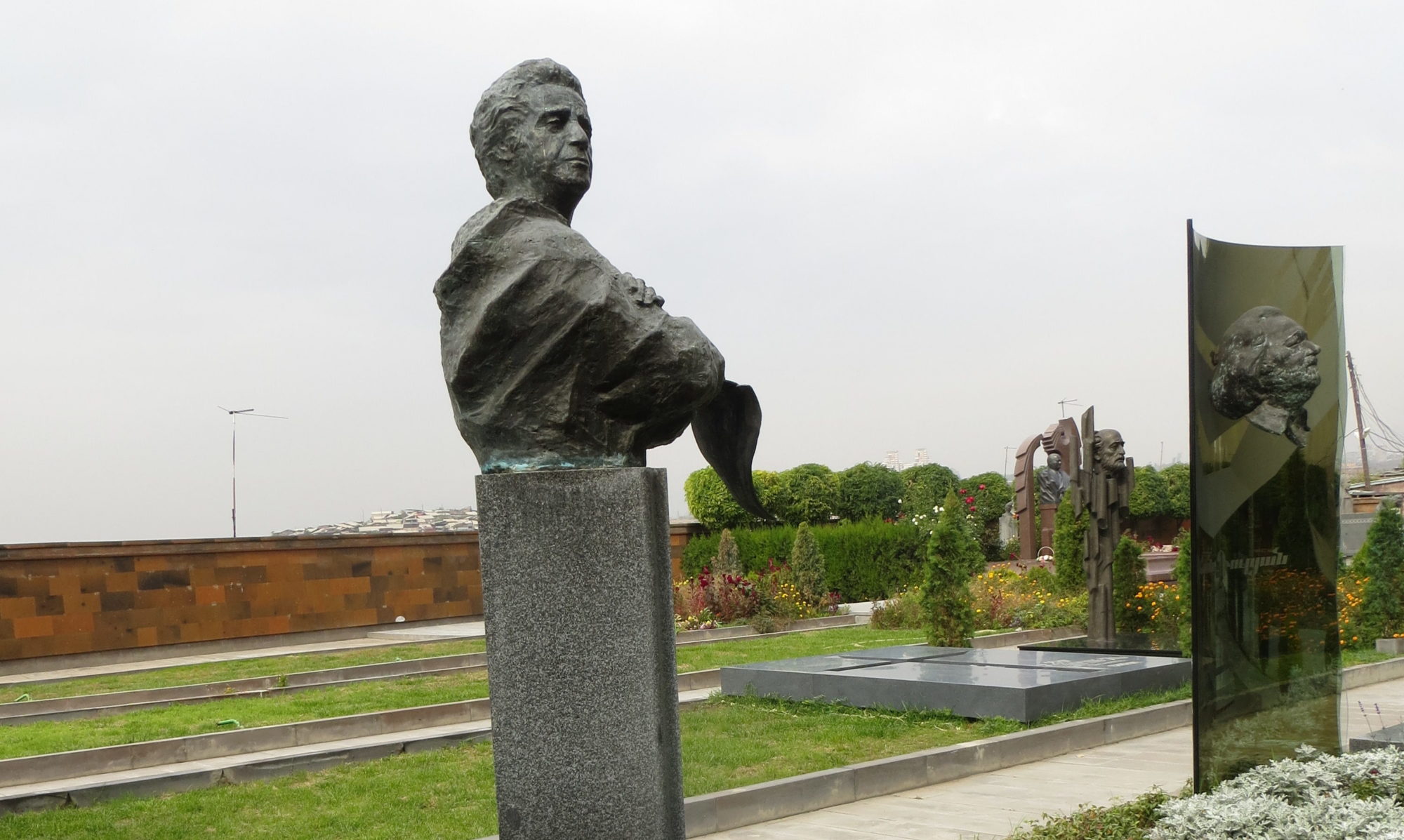
Life & Career
Alexander Arutiunian was born in Yerevan on September 23, 1920, just months before the establishment of Soviet Armenia in the wake of the 1915–1917 Armenian Genocide. Entering the Yerevan Conservatory in 1927, he studied piano and composition through 1941 before moving to Moscow in 1946–1948 for postgraduate study at the House of Armenian Culture under composer and theorist Genrikh Litinsky. Alongside lifelong friend and co-author Arno Babajanyan and fellow composers Edward Mirzoyan, Lazar Saryan, and Adam Khudoyan, Arutiunian belonged to the celebrated postwar circle often called the “Armenian Mighty Handful.”
In the aftermath of the 1948 Zhdanov decree, Arutiunian achieved national acclaim with works combining clear formal architecture, accessible lyricism, and Armenian musical color — an idiom examined in Dr. Fred Sienkiewicz’s doctoral dissertation as the “Big Soviet” Armenian style. His Cantata about the Motherland (1948) won the Stalin Prize in 1949, followed rapidly by the Festive Overture (1949) and the Concerto for Trumpet and Orchestra (1950). Originally inspired by Armenian trumpeter Tsolak Vardazaryan (who died in 1943) and completed at the urging of Bolshoi Theater soloist Haykaz Mesiayan, the Trumpet Concerto received its 1950 premiere and 1951 radio broadcast with Mesiayan before virtuoso Timofei Dokshizer carried it onto international stages starting in 1959.
Returning permanently to Yerevan, Arutiunian shaped Armenian musical life for decades as Artistic Director of the Armenian State Philharmonic (1954–1990), Professor of Composition at the Yerevan Komitas State Conservatory (1965–2006), and a longtime board member of the Soviet Composers’ Union; he was named People’s Artist of the USSR in 1970. Across a career spanning seven decades, he produced more than 125 compositions: 18 concerti, 17 piano works, 11 orchestral works, 21 chamber works, 6 cantatas, over 35 songs and romances, 18 choral works, the opera Sayat-Nova (1968), and 6 film scores. After Armenia’s devastating 1988 Spitak earthquake and the dissolution of the Soviet Union, his late style turned more rhapsodic and reflective in works such as the Violin Concerto Armenia-88 (1988), Rhapsody for trumpet and winds (1990), the Trombone Concerto (1991), the Tuba Concerto (1992), and Elegy (2000). Arutiunian died in Yerevan on March 28, 2012 and is buried at the Komitas Pantheon.
Musical Language
Arutiunian’s compositional voice draws directly on Armenian monodic folk and sacred traditions. Rather than relying on Western major-minor harmony alone, his melodies frequently unfold within modal pitch centers enriched by augmented seconds — echoing fifth-century sacred hymnody as well as eighteenth-century ashugh (minstrel) declamation, which often begins urgently in an upper register before descending into lyrical reflection.
Timbral and rhythmic references to traditional instruments permeate his scores: sustained lamentations invoke the expressive duduk, rapid muted passages imitate the reed zurna, and driving asymmetrical meters echo Armenian peasant dances such as Trnotsi and Jeirani pes. Arutiunian fused these native elements with the orchestration, counterpoint, and formal clarity of Armenian predecessors — Komitas, Aleksandr Spendiaryan, and Aram Khachaturian — alongside Russian and Soviet masters including Rimsky-Korsakov, Tchaikovsky, Prokofiev, and Shostakovich.
Timeline
- 1920 Born September 23 in Yerevan, Armenia.
- 1927–1941 Studied piano and composition at the Yerevan Conservatory.
- 1943–1950 Began sketching a trumpet concerto inspired by Tsolak Vardazaryan; completed it for Bolshoi Theater soloist Haykaz Mesiayan (premiered 1950, radio broadcast 1951).
- 1946–1948 Postgraduate study in Moscow at the House of Armenian Culture with Genrikh Litinsky.
- 1948–1949 Composed Cantata about the Motherland (1948; awarded the 1949 Stalin Prize) and Festive Overture (1949).
- 1954–1990 Served as Artistic Director of the Armenian State Philharmonic in Yerevan.
- 1959–1969 Timofei Dokshizer introduced the Trumpet Concerto to Western audiences (1959), wrote the standard published cadenza (before 1965), and recorded it in 1969.
- 1965–2006 Taught as Professor of Composition at the Yerevan Komitas State Conservatory; named People’s Artist of the USSR in 1970.
- 1968 Premiered the opera Sayat-Nova, celebrating the eighteenth-century Armenian poet-ashugh.
- 1988–2000 Composed late-period masterworks including Armenia-88 (1988), Rhapsody (1990), Trombone Concerto (1991), Tuba Concerto (1992), and Elegy (2000).
- 2012 Died March 28 in Yerevan; laid to rest at the Komitas Pantheon.
Spelling & Transliteration
Official International Spelling: Alexander Arutiunian
Note the -iu after the t and -ian at the end. Because scores and recordings were issued across Armenian, Soviet, French, German, and American publishing houses, you will encounter several spelling variants when searching library catalogs or sheet music vendors.
| Context | Spelling | Notes & Pronunciation |
|---|---|---|
| International (Official) | Alexander Arutiunian | Preferred international and scholarly spelling |
| Armenian | Ալեքսանդր Հարությունյան | Alek-sandr Har-oo-tyoon-yan (native orthography) |
| Russian | Александр Арутюнян | Alek-sandr Aroo-tyun-yan (Soviet-era editions) |
| United States Editions | Alexander Arutunian | International Music Company (Trumpet Concerto) |
| French Editions | Alexandre Aroutounian | Alphonse Leduc (Aria et Scherzo) |
| German Catalogs | Alexander Arutjunjan | German-language reference works and broadcasts |
| Library / IMSLP Variants | Alexander Arutyunyan / Harutyunyan | Direct Cyrillic and Armenian transliterations |
Continue Exploring
Browse recordings across all genres in the Works Catalog, explore dedicated scores and performances in Trumpet Repertoire, or read about the doctoral dissertation and conference talks in Research & Talks.