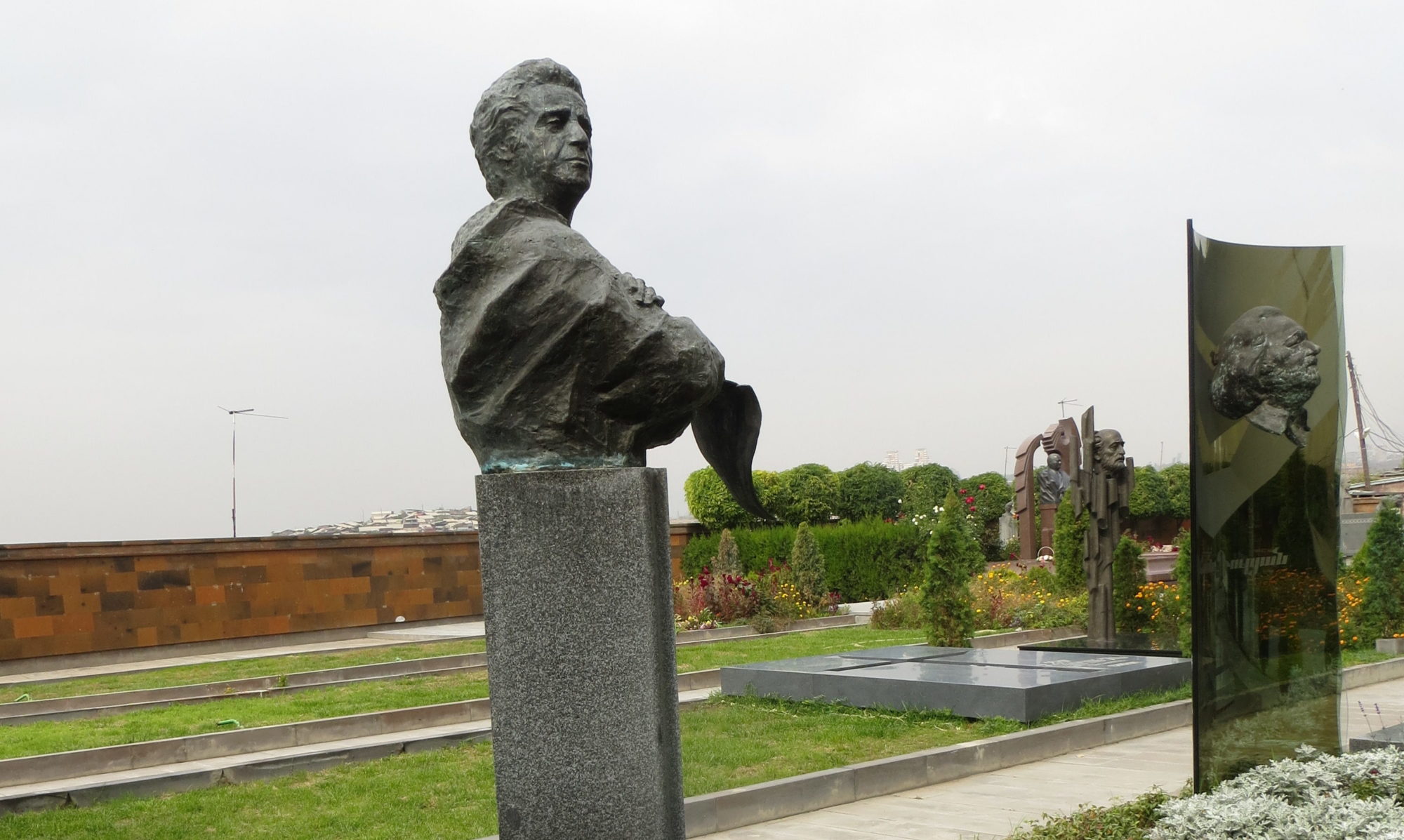
Alexander Arutiunian trained under founders of the Armenian nationalist school—composers who blended Armenian monodic folk and minstrel traditions with techniques drawn from nineteenth-century Russian nationalism and French Impressionism. This primer condenses Chapter One of Dr. Fred Sienkiewicz’s doctoral dissertation (Forefathers, Antecedents, and the Development of Alexander Arutiunian’s ‘Big Soviet’ Armenian Style, Boston University, 2019), paired with selected recordings.
Historical Context

Armenian culture traces its origins to the second and third millennia B.C.E., and its Kingdom reached its greatest territorial extent across the Armenian highlands and Levant in the first century B.C.E. Early in the fourth century (c. 301–315 C.E.), Armenia became the first state to formally adopt Christianity; in 405 C.E., Bishop Mesrop Mashtots created the Armenian alphabet, prompting translations of the Bible and other foundational texts. By the time the first Armenian histories were written in the fifth century, distinctive local musical practices were already well established.
Thirteenth-century Mongol invasions shattered the Armenian feudal kingdoms and scattered the nobility, inaugurating seven centuries of rule under Mongol, Persian, Ottoman, and Russian empires. Living as an ethnic and religious minority, Armenians preserved their identity through rural village life, the Armenian language, an independent national church, and oral musical traditions. In the mid-nineteenth century, a prosperous Armenian merchant class in Tbilisi and Constantinople (Istanbul) spearheaded a cultural revival, sponsoring young musicians to study in Russia and Western Europe before returning to build a professional Armenian concert life.
In 1915, the Ottoman government’s Armenian Genocide killed more than one million Armenians, depopulated Western Armenia, and severed much of the rural oral tradition; pre-1915 transcriptions—above all those of Komitas—became in many cases the sole surviving record of that repertoire. After the Red Army entered Yerevan in late 1920 and established Soviet Armenia, invited artists and educators built modern national institutions in a once-provincial town, founding the Yerevan State Conservatory (1923, from Ṛomanos Melik’yan’s 1921 music studio), the Armenian Philharmonic Orchestra (1926), and the Yerevan Opera and Ballet Theater (1933).

Three Pillars of Traditional Armenian Music
Traditional Armenian music comprises three mutually influencing branches: village peasant song, the music of professional gusans and ashughs, and the liturgical chant of the Armenian Church. All three are monodic—built on single-line melody and modal nuance rather than European harmony and counterpoint or the multi-part polyphony of neighboring Georgia. Multi-voice elements in traditional performance are limited to tonic drones (shifting at modulation points), rhythmic ostinatos, and antiphonal alternation between soloists or choirs.
There can exist monophonic music which is far more complicated and able to express a higher cultural level than many polyphonic styles. Talented Armenian [folk-music] composers of old, embracing the limits of the folk music available to them, were dedicated to the mastery of melodic creation and were far ahead of their time in this respect.
Peasant Song & Folk Instruments
Peasant song is the oldest branch, tied closely to agricultural and domestic labor, weddings, seasonal ceremonies, pilgrimages, and exile. In fieldwork conducted c. 1890–1910, Komitas observed that villagers strictly matched each genre to its proper occasion: threshing songs belonged exclusively to the threshing floor, while antuni (“homeless” songs) were sung by or for expatriates far from home. Work and dance tunes are often concise (4–16 measures) and narrow in range (frequently a fourth or fifth). Because spoken Armenian stresses the final syllable of most words, melodies favor iambic (short–long) rhythms; dance songs such as Tvek, Tvek and Postan em use compound and asymmetrical meters of 5, 7, 8, 9, and 11. Narrative epics like Surb Karapet unfold in wider-ranged, speech-like declamation, while lyrical songs such as Partk’ov kove (“For debt I sold my ox”) repeat short stepwise and third-based motives across shifting metric accents.
Peasant instrumental music imitates vocal phrasing on native instruments including the breathy double-reed duduk, the loud double-reed zurna, the blul or sring flute, and the dhol field drum, typically in two- or three-player groups where one plays the melody over a sustained drone. Below, soprano Isabel Bayrakdarian and the Minassian Duduk Quartet perform the traditional folk lament Dle Yaman (Դլե Յաման)—a melody Arutiunian himself later set in his score for the 1977 film Nahapet:

Dle Yaman (Դլե Յաման) — Isabel Bayrakdarian, soprano, and the Minassian Duduk Quartet (2004).
Liturgical Chant: Sharakans & Sacred Taghs
Founded in the fourth century, the Armenian Church adopted Christian psalm-chanting and hymn-singing formats while drawing its musical idiom from Armenian peasant and gusan traditions. Its principal liturgical form, the sharakan (hymn), reached a canon of roughly 1,300 chants by the early seventeenth century, sung antiphonally by two choirs alternating verses over a tonic drone. After the ninth century, church composers also cultivated the tagh—a personal, virtuosic, and richly melismatic song form shared with secular gusans, exemplified by the tenth-century Havun, Havun (Հավուն, հավուն, “Bird, Bird”), attributed to St. Grigor Narekatsi (c. 951–1003).
Although sacred chant shares the modal foundation of Armenian folk music, specific church repertoire had limited direct influence on Soviet Armenian concert composers. Aside from official settings of the Surb Patarag (Holy Liturgy) by Makar Yekmalyan and Komitas, the Armenian Church barred secular performance of liturgical music, and Stalin-era state atheism prohibited sacred borrowings—making Arutiunian’s 1965 choral Requiem (composed for the fiftieth anniversary of the Genocide on the eleventh-century sharakan Gt’a ter, “Lord Have Mercy”) a rare exception.

Havun, Havun (Հավուն, հավուն) — performed by Armenian soprano Lusine Zakaryan. Compare the National Chamber Choir of Armenia recording of Havun, Havun on YouTube and the fifth-century sharakan Yekyalks (“We Are Gathered”) performed by the Haissmavourk Choir on YouTube.
Gusan & Ashugh Minstrel Traditions
Professional minstrels known as gusans were well established by the fifth century C.E.: historian P’avstos Buzand called their tales and songs “the spiritual food of the peasants,” while noble courts retained gusans for festivals, feasts, and martial epics. As foreign rule scattered the Armenian nobility, the gusan tradition declined and was superseded in the seventeenth and eighteenth centuries by ashughs—urban poet-musicians active across Turkish, Persian, Georgian, Azerbaijani, and Armenian centers who sang impassioned, oratorical verse to Persian-derived stringed instruments such as the saz, tar, and bowed k’amancha.
The foremost Armenian ashugh was Sayat’-Nova (born Harut’yun Sayadyan, c. 1712–1795; his Persian stage name means “King of Songs”), who worked in Tbilisi and composed in Armenian, Georgian, and Azerbaijani. Alongside rhythmic dance tunes, ashugh repertoire included unmetered, recitative-like declamatory songs—a template later adopted by classical Armenian composers. These songs open intensely near the top of the singer’s range (often a seventh or octave above tonic) and relax across successive descending phrases to a final tonic cadence, as heard in Sayat’-Nova’s Dun en glkhen (Դուն էն գլխեն, “You Are Wise”):

Dun en glkhen (Դուն էն գլխեն) by Sayat’-Nova — Sayat-Nova Folksong Ensemble (300th anniversary concert). Also hear Mavr Mkrtchyan’s performance with k’amancha and blul on YouTube and the Hamazkayin Music ensemble rendition of Dun en glkhen on YouTube.
By contrast, rhythmic ashugh dance songs span a narrower vocal range and often use periodic two-measure “empty downbeat” phrasing—another hallmark adopted by composers of the Armenian school, including Arutiunian. Because a strummed or bowed drone ostinato supplies the strong beat-one impulse, the vocal melody rests or holds across the downbeat of the first bar and drives forward into the second, as heard in Sayat’-Nova’s ode to his instrument, K’amancha (Քամանչա / Amen sazi mejn govats):

K’amancha (Amen sazi mejn govats, Ամեն սազի մեջն գոված) by Sayat’-Nova — Sayat-Nova Ensemble, dir. Tovmas Poghosyan. Also compare another traditional rendition of K’amancha on YouTube.
Transition to Armenian Classical Music (1860s–1930)
Early Western-trained Armenian composers approached national music from distinct regional spheres. In Constantinople, Italian-educated Tigran Chukhajyan (Dikran Tchouhadjian, 1837–1898) wrote the historical tragedy Arshak II (1868), the first Armenian opera; modeled closely on Verdi rather than Armenian folk monody, it fell out of circulation under Ottoman censorship and remained unknown in Eastern Armenia until Soviet musicologists revived it in the 1940s. In Eastern Armenia, by contrast, Armen Tigranyan (1879–1950)—a Gyumri native who studied in Tbilisi with Makar Yekmalyan—built his village tragedy Anush (composed 1908, premiered 1912, re-orchestrated for the Yerevan Opera in 1935, after Hovhannes T’umanyan’s poem) directly on peasant and ashugh idioms:

Armen Tigranyan — Anush’s aria (Asum en uṛin) from Anush (Անուշ), performed by soprano Asmik Grigorian. Also see a full staged production of Anush by the Armenian National Opera and Ballet Theater on YouTube.
Most founders of the Eastern Armenian school trained under or alongside Russia’s St. Petersburg Mighty Handful (“Moguchaya Kuchka”: Balakirev, Rimsky-Korsakov, Mussorgsky, Borodin, and Cui). As Marina Frolova-Walker shows in Russian Music and Nationalism from Glinka to Stalin, the Kuchka had limited contact with actual Russian folksong and defined “national” style largely negatively—avoiding European V–I cadences in favor of modified dominants, plagal motion, open-fifth pedals, counterpoint, asymmetric meters, and Orientalist devices such as Rimsky-Korsakov’s lowered-sixth “harmonic major.” Armenian composers adopted this technical framework alongside genuine ethnomusicological fieldwork, moving across two generations from harmonizing traditional melodies to composing original works grounded in Armenian modal and rhythmic syntax.
Key Architects of the Armenian National School
K’ristap’or Kara-Murza (1853–1902)
Crimean-born K’ristap’or Kara-Murza was the first to transcribe peasant and ashugh melodies and present four-part choral arrangements on concert stages across Transcaucasia. Untrained in the Russian Kuchka tradition, he harmonized folk songs such as Zim vzi vznots kitam (“I Am Wearing a Necklace”) in straightforward European homophony without Orientalist augmented seconds. Between 1885 and 1902 he organized roughly 90 choirs in 47 cities, gave 248 concerts with over 6,000 singers, and taught a young Komitas during a brief 1892–1893 post at the Etchmiadzin Seminary (Jemaran):

K’ristap’or Kara-Murza — Zinch u zinch and Zim vzi (Զինչ ու զինչ – Զիմ վզի), performed by the Armenian National Radio State Choir.
Makar Yekmalyan (1856–1905)
Vagharshapat native Makar Yekmalyan assisted Nikoghayos T’ashjian’s chant transcriptions at Etchmiadzin before studying at the St. Petersburg Conservatory (1879–1888) under Rimsky-Korsakov and teaching in Tbilisi. Combining triadic homophony with plagal cadences, open fifths, and Rimsky-Korsakov’s harmonic major, Yekmalyan’s harmonized Surb Patarag (Սուրբ Պատարագ, Holy Liturgy)—premiered in St. Petersburg in 1893, praised by Balakirev, Verdi, and Saint-Saëns, and adopted by the Armenian Church in 1895—remains the standard setting sung in Armenian churches today:

Makar Yekmalyan — Surb, Surb (Սուրբ, Սուրբ, “Holy, Holy”) from Surb Patarag (Holy Liturgy).
Komitas Vardapet (1869–1935)
Regarded by Armenians as the father of national classical music, priest, ethnomusicologist, and choirmaster Komitas (born Soghomon Soghomonyan in Kütahya, Ottoman Empire) studied at the Etchmiadzin Jemaran with Kara-Murza, continued with Yekmalyan in Tbilisi, and completed conservatory and musicology studies in Berlin (1896–1899), becoming a charter member of the International Music Society. Teaching at Etchmiadzin (1899–1910) and later leading the 300-voice Gusan Choir in Constantinople, he transcribed 3,000 to 4,000 folk songs. Arrested with 200 Armenian intellectuals on April 24, 1915 at the start of the Genocide, Komitas suffered a breakdown that ended his career in 1916; at least 1,200 of his transcriptions survived and were published.
Like Kara-Murza and Yekmalyan, Komitas devoted his compositional output mainly to setting traditional melodies—in choral works, his contrapuntal Surb Patarag, solo piano dances, and voice-and-piano folk arrangements. Rejecting Orientalist formulas, he developed two main approaches: spare, Renaissance-inspired counterpoint paired with fifth drones (often harmonizing a melody’s modal final as the fifth above the bass, as in Baghi pat), and slow, non-functional Impressionist sonorities spanning the keyboard (as in Antuni).
If Komitas had written only Antuni, this would have been sufficient to rank him as a great musician.

Komitas — Antuni (“Homeless”), performed by Ruzan Mantashyan, soprano, and Kirill Gerstein, piano. Also hear Armenak Shahmuradian’s historic 1912 recording of Antuni on YouTube and the Yerevan State Chamber Choir performance of Komitas’s Garun a on YouTube.
Ṛomanos Melik’yan (1883–1935)
Educated at the Moscow Conservatory (with Ippolitov-Ivanov and Taneyev) and St. Petersburg Conservatory (with Maximilian Steinberg and Vasily Kalafati), Ṛomanos Melik’yan resettled in Yerevan in 1921, founded the Yerevan State Conservatory (1923) as its first rector, and in 1933 became the first artistic director of the Yerevan Opera and Ballet Theater. After transcribing folk songs among Genocide survivors in Van during a 1916 relief mission, Melik’yan established the Armenian Romance (art song) with his cycle Zmrukhti (“Emerald Songs,” 1916–1918), composing original modal melodies over non-functional, Impressionist piano accompaniments colored by consonant added seconds—illustrated in Oror (Օրոր, “Lullaby”):

Ṛomanos Melik’yan — Oror (Օրոր, “Lullaby”) from Zmrukhti (1916–1918).
Alexander Spendiaryan (1871–1928)
A private student of Rimsky-Korsakov in St. Petersburg, Crimean-born Alexander Spendiaryan moved to Yerevan in 1924 to teach at the Conservatory and founded the Armenian Philharmonic Orchestra in 1926. His two-movement orchestral work Yerevan Sketches (1925) and posthumously completed opera Almast (premiered in Moscow in 1930 and chosen to inaugurate the Yerevan Opera in 1933, which now bears his name) set the template for Armenian orchestral and operatic writing. Blending Armenian ashugh song and regional mugham/mawwal prelude–dance structure with native percussion (daira and dhol), Yerevan Sketches opens in Enzeli by setting Sayat’-Nova’s Dun en glkhen over fifth drones before a fast 6/8-against-3/4 dance—a polymetric texture not found in monodic folk practice, but adopted across the Armenian classical school as an emblem of folk rhythmic vitality—while Hijaz imitates a village duduk pair with solo oboe over an English-horn drone. Hearing Spendiaryan conduct Yerevan Sketches was seven-year-old Arutiunian’s first experience of a symphony orchestra; he picked out the harmonies by ear at home and played Enzeli at his Conservatory audition for Spendiaryan.

Alexander Spendiaryan — Yerevan Sketches (Yerevan Studies), Op. 30 (1925): I. Enzeli and II. Hijaz.
Sargis Barkhudaryan (1887–1972)
Tbilisi native Sargis Barkhudaryan—who played for Komitas at age twelve before studying in Berlin and St. Petersburg—taught composition for over thirty years at the Tbilisi Conservatory and commuted to Yerevan (1933–1937) as Arutiunian’s first composition professor. Although he also arranged folk and Sayat’-Nova songs, most of his output consists of newly composed piano miniatures such as Eastern Dances (1910–1913) and Naz-Par (c. 1910) that emulate peasant dance rhythms and modal contours. His characteristic moving open-fifth basses, added seconds emphasizing melodic peaks, ternary prelude–dance forms, and early use of 6/8-against-3/4 polymeter (in Naz-Par) carried directly into Arutiunian’s student works.
Sargis Barkhudaryan — Naz-Par (c. 1910) · Mikael Ayrapetyan, piano.
Aram Khachaturian (1903–1978)
Born in Tbilisi and trained in Moscow at the Gnessin Institute and the Moscow Conservatory (under Mikhail Gnessin and Nikolai Myaskovsky), Aram Khachaturian brought Soviet Armenian music international renown with his Piano Concerto (1936) and Violin Concerto (1940). Arutiunian and his Yerevan peers looked up to Khachaturian as a trailblazing model—traveling to Moscow’s Armenian House of Culture in 1946 hoping to study with him before Khachaturian arranged their lessons with his own former teacher Genrikh Litinsky while remaining an active mentor. Because Khachaturian lived in Moscow from 1921 and rose to fame during Arutiunian’s student years, his strongest impact on Arutiunian’s writing came in the late 1940s and 1950s. Like Melik’yan and Barkhudaryan, Khachaturian made consonant seconds a hallmark of his style, though at Myaskovsky’s urging he largely avoided static drones in favor of mobile symphonic basslines—a key contrast with Arutiunian’s continued use of pedal points and drones.
Take my passion for [seconds] for which the critics and Conservatory teachers would turn on me (except Myaskovsky, of course). They have been a part of me since my childhood, when I used to hear trios of folk instruments—the tar, k’amancha, and tambourine [daira]. I delighted in them, taking the piercing sounds of the intervals as perfect consonances.
Khachaturian’s melodic imprint on Arutiunian is unmistakable in the lyrical second theme from the first movement of Khachaturian’s Cello Concerto (1946, queued below to 4:27), which closely anticipates the slow central episode of Arutiunian’s 1950 Trumpet Concerto:

Aram Khachaturian — Concerto for Cello and Orchestra in E minor (1946), I. Allegro moderato (second theme, queued to 4:27) · Denis Shapovalov, cello; Tchaikovsky Symphony Orchestra, cond. Vladimir Fedoseyev.
From Tradition to Alexander Arutiunian
Educated in Yerevan by these pre-Soviet pioneers and their colleagues, Alexander Arutiunian drew on both the Russian-nationalist and Impressionist currents of the Armenian school from his earliest works. His student piano piece Armenian Dance (1935) adopts Barkhudaryan and Spendiaryan’s prelude–dance plan and 6/8-against-3/4 polymeter. His Concerto for Trumpet and Orchestra (1950) opens with an ashugh-style declamatory recitative built on augmented tetrachords over a dominant pedal—echoing Spendiaryan’s setting of Sayat’-Nova’s Dun en glkhen in Enzeli—and contrasts it with peasant-song lyricism in the development; Dun en glkhen itself opens the overture to Arutiunian’s opera Sayat-Nova (1969) in counterpoint. Across his orchestral, choral, and brass works, drones, added seconds, modified dominants, asymmetrical dance meters, and orchestral evocations of the duduk and zurna carry these pre-1930 traditions forward.
Continue exploring through Arutiunian’s Biography & Timeline, browse scores and recordings in the Works Catalog and Trumpet Repertoire, or read the full dissertation and lecture notes under Research & Talks.